Written by Zoe McPherson, RAHS Volunteer
The Royal Australian Historical Society is working to make more of its unique collections discoverable online through the RAHS Library Catalogue, giving members, affiliated societies, researchers and history enthusiasts greater access to the material held by the Society.
An important part of this process is reviewing and re-cataloguing the manuscript collection. As we work through the collection, we are finding that not everything traditionally housed within it is a manuscript. The review is uncovering ephemera and other intriguing items that can now be described and catalogued more accurately, making them easier to find and explore through Liberty, the RAHS Library’s catalogue software.
One particularly intriguing find is Our Early Days: A Bicentennial Compendium of Historical Activities, a 33-page children’s fun book produced by the RAHS for the Pizza Hut division of PepsiCo Australia.
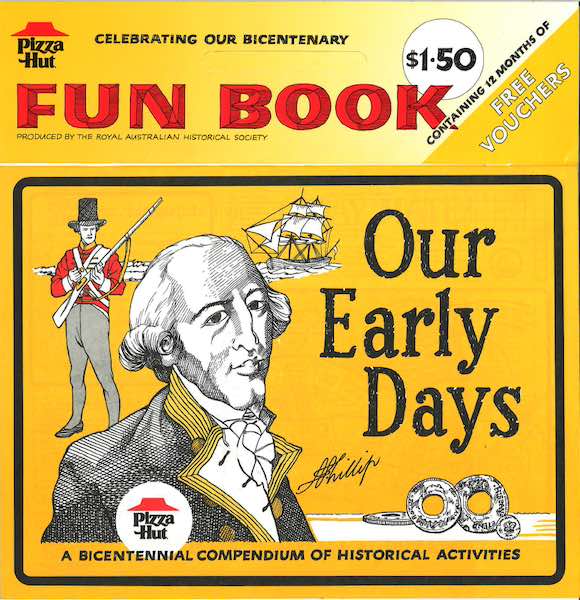
Our Early Days: A Bicentennial Compendium of Historical Activities held in the RAHS Collection
The booklet was produced for sale through Pizza Hut restaurants during January and February 1988. With a print run of 100,000 copies, the project was also a financial success for the Society.
The project was the brainchild of then RAHS Treasurer Robert Clarke, who, together with his wife Anne Clarke and then RAHS President Robert Irving, put together the children’s fun book. Combining historical facts, games and activities, it introduced young audiences to Australia’s early history in an accessible and entertaining format.
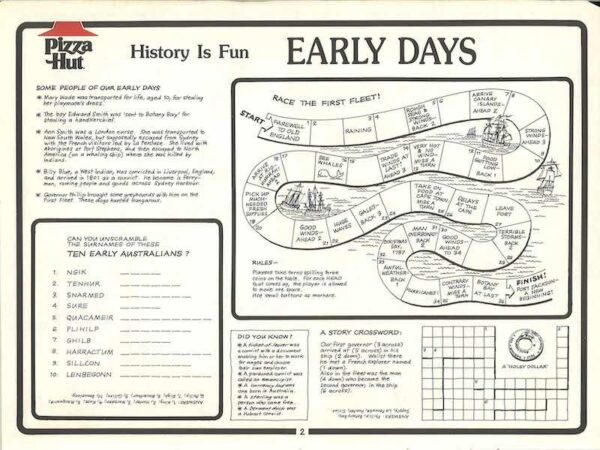
Examples of activities in the Our Early Days fun book held in the RAHS Collection.
Today, Our Early Days provides a fascinating insight into public history practice in the 1980s. Its illustrations, activities, language and format show how history was communicated to mass audiences through education, entertainment and popular culture. It also offers an opportunity to consider the historical narratives promoted during Australia’s Bicentenary and the emphasis placed on the country’s colonial history.
As a historical source, the fun book tells us something not only about the history presented within its pages, but also about how Australian history was being interpreted and shared with the public at the time.
Our Early Days is just one example of the unexpected material being rediscovered as we review the collection. Re-cataloguing these items and making their records available through Liberty will make it easier for researchers and the wider community to discover and explore the diverse material preserved by the RAHS.
For more information on the RAHS collections, please contact RAHS Librarian Donna Newton at library@rahs.org.au.
0 Comments